Military Media Management by Sarah Maltby
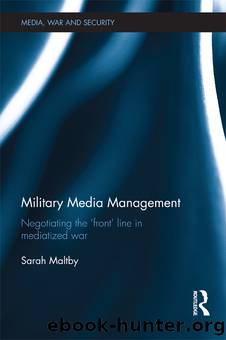
Author:Sarah Maltby [Maltby, Sarah]
Language: eng
Format: epub
Tags: History, Military, General, Social Science, Media Studies, Political Science, Political Freedom
ISBN: 9781136335563
Google: E97GBQAAQBAJ
Publisher: Routledge
Published: 2013-02-28T15:55:14+00:00
Competing definitions
As stated earlier, the military attempt to reveal and conceal information about their activities through linguistic, visual and narrative control moves. In an environment where technological advances allow the media to cover events as they unfold, and in accordance with the media âflash to bangâ demands for constant information, ongoing and evolving tactical activities must therefore be defined as they occur. Implicitly, and in line with the traditional reticence that is still evident in Media Operations practice, the military would undoubtedly rather conceal information about their tactical actions until definitions can be formulated with some certainty. However, owing to the nature of the environment in which they operate and the contest of assessment that occurs with media observers, the delivery of military definitions requires speed. In their own terms, the military state that they can win or lose the definition of an incident in the first hour.10 When incidents are not defined, the military believe that the media are more likely to engage in speculation regarding what may be happening in the battle space, or regarding the military's motives for concealing information. Thus, they argue that they always attempt to provide definitions and explanations of situations as quickly as possible.
Concurrently, they argue that when working toward media demands for immediacy they are limited in their capacity to ensure the accuracy and consistency of definitions of tactical activity due to the speed at which a battle may evolve.11 In these cases they argue it is not uncommon for the âfirstâ report of front-line activity to be wrong, or to change within a matter of hours, given that it is based upon rapidly changing scenarios.12 As one Channel 4 correspondent stated of his experience of the inaccuracy of information he was given during the Iraq War:
Day after day after day we were told Um Qsar had fallen and Um Qsar hadn't fallen. Then day after day we were told that Safwan had fallen. It hadn't. Then we were told Az Zubayr day after day had. It hadn't. We killed Chemical Ali and then last week, oh no we haven't. As Colonel Chris Vernon said âWell we are 99.9% sure that we killed himâ well it was the 1% wasn't it â I'm sorry, egg on face. . . . Then we got to Basra and it all got completely silly, first of all there was the rebellion that never existed. Then there was their firing on people leaving Basra, which they weren't. Then they are leaving in droves from Basra to escape, which they weren't. Then the tank column escaping from Basra which didn't happen, or it certainly didn't happen in the numbers like they said it would.
(Channel 4 correspondent, interview data)
While this level of inaccurate information provision generates a potential for competing definitions, it must also be borne in mind that there may be short-term strategic and tactical benefits in the dissemination of inaccurate âfirst reportsâ to and through the media. With reference to the example above, the military certainly
Download
This site does not store any files on its server. We only index and link to content provided by other sites. Please contact the content providers to delete copyright contents if any and email us, we'll remove relevant links or contents immediately.
Spell It Out by David Crystal(36220)
Life for Me Ain't Been No Crystal Stair by Susan Sheehan(35895)
The Great Music City by Andrea Baker(33427)
Cecilia; Or, Memoirs of an Heiress — Volume 1 by Fanny Burney(32712)
Cecilia; Or, Memoirs of an Heiress — Volume 2 by Fanny Burney(32075)
Cecilia; Or, Memoirs of an Heiress — Volume 3 by Fanny Burney(32058)
Professional Troublemaker by Luvvie Ajayi Jones(29744)
The Secret History by Donna Tartt(19443)
We're Going to Need More Wine by Gabrielle Union(19162)
Twilight of the Idols With the Antichrist and Ecce Homo by Friedrich Nietzsche(18761)
All the Missing Girls by Megan Miranda(16645)
Cat's cradle by Kurt Vonnegut(15538)
For the Love of Europe by Rick Steves(14863)
Pimp by Iceberg Slim(14778)
Bombshells: Glamour Girls of a Lifetime by Sullivan Steve(14210)
Norse Mythology by Gaiman Neil(13555)
Talking to Strangers by Malcolm Gladwell(13520)
Fifty Shades Freed by E L James(13339)
The Social Justice Warrior Handbook by Lisa De Pasquale(12286)
